
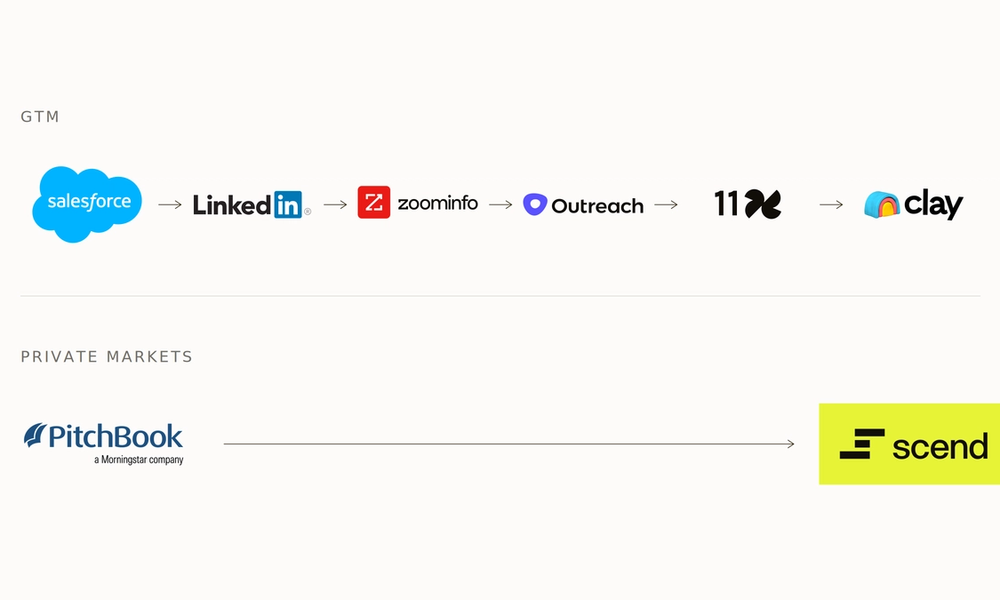
Recently, private equity (PE) has really started to focus on generating proprietary deal flow.
Attending industry conferences, quarterly pings to investment bankers, cold calling founders, mailers, and sending thousands of introductory emails have all become standard parts of the origination playbook.
Meanwhile, an entirely different industry has spent the last 25 years building software to automate pretty similar activities.
What started as software to organize sales relationships has evolved into systems that find companies, validate decision-makers, execute outreach, and increasingly decide which relationships are worth pursuing long-term.
We can tell that more of that technology is about to find its way into private markets.
Not because PE firms love email spamming, but because they hate overpaying for companies in banker-led auctions. Intermediated deals are expensive and proprietary deal origination and go-to-market (GTM) are fundamentally more similar than most people initially realize.
A brief history of outbound
GTM technology has progressively reduced the cost of identifying and contacting more potential customers.
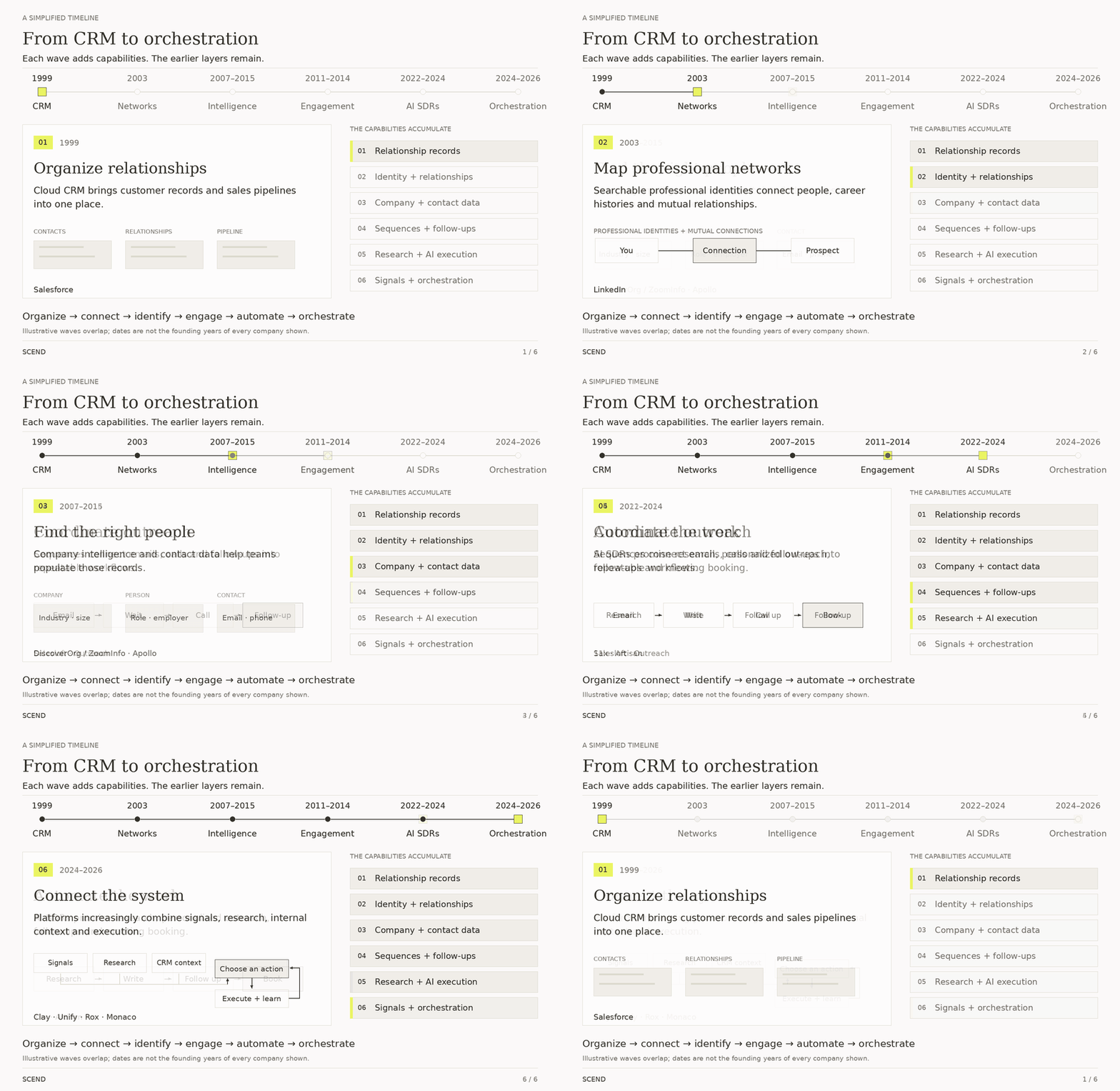
Here's a very simplified timeline:
- 1999: Salesforce helped popularize cloud-based CRM and made customer relationships and pipelines easier to organize.
- 2003: Linkedin made professionals and jobs visible online.
- 2007–2015: ZoomInfo and Apollo emerged to help populate CRMs with decision maker's contact info (emails and phone numbers).
- 2011–2014: Salesloft and Outreach scaled email sequences, calls, and follow-ups.
- 2022–2024: Companies like 11x and Artisan promised AI sales development representatives (SDRs) that could research prospects, write emails, follow up, and book meetings without much human involvement.
- 2024–2026: Clay, Unify, Rox, and Monaco increasingly combined intelligence, buying signals, internal sales context, AI agents, and campaign execution.
The first wave of AI SDRs generated enormous excitement, but the early results were VERY mixed.
In March 2025, TechCrunch reported that some early 11x customers experienced disappointing performance, including inaccurate outreach and hallucinations. Several companies disputed being represented as customers on its website.
The larger trend hasn't slowed and 11x was onto something important. Models have improved, and the industry has increasingly recognized that context and data quality matter just as much as email generation.
In September 2026, Clay raised $115M at a $7.1B valuation, reporting more than 17,000 customers. More importantly, its vision helps crystallize where the GTM market is going: full orchestration.
The outbound stack is collapsing
Historically, businesses purchased different software for different parts of sales development.
Contact intelligence: ZoomInfo and Apollo identify companies, decision-makers, and contact information.
Execution: Salesloft, Outreach, Smartlead, Instantly, lemlist, and HeyReach help teams reach those people through email, LinkedIn, and other channels.
AI SDRs: 11x, Artisan, and others automate research, personalization, follow-ups, and meeting booking.
Orchestration: Clay, Unify, Rox, and Monaco increasingly connect these capabilities into systems that decide what to do and help execute it.
The boundaries are quickly disappearing as it gets much easier to ship features and integrate more of the GTM software stack.
Clay now combines research, enrichment, and its own email Sequencer. Unify uses buying signals, like website visits, to trigger outreach. Rox incorporates internal CRM histories and account relationships. Monaco combines outbound execution with an AI-native CRM.
They're moving from tools that help salespeople perform specific GTM tasks toward systems that continuously identify opportunities and act on them.
They're designed around GTM: selling something to a customer.
Many times, an important commercial opportunity isn't a customer.
Deal origination is not that different from sales prospecting
Consider a PE-backed commercial HVAC company looking to double its revenue.
It could:
- Win more customers.
- Acquire smaller HVAC operators.
- Develop referral relationships with property managers.
- Partner with regional contractors.
- Recruit executives who can open new markets.
- Build relationships with bankers and attend industry conferences.
- Find lenders to finance its M&A strategy.
Traditionally, these activities would be managed across different departments, data vendors, databases, and workflows.
Underneath, they're pretty similar.
Find the opportunity. Research the market. Identify the right people. Evaluate fit. Develop relationships. Execute. Learn.
The same underlying infrastructure could support all seven strategies. What changes is the intelligence needed to pursue each one.
Winning a commercial customer requires understanding purchasing needs, decision-makers, and buying signals.
Acquiring an HVAC operator requires understanding ownership, estimated EBITDA, comparable transactions, and potential seller motivations.
Finding financing requires understanding lenders' mandates, transaction histories, and appetite for the particular deal.
The basic workflow remains recognizable even as the information and economic objectives change.
Private markets is complex, in a different way
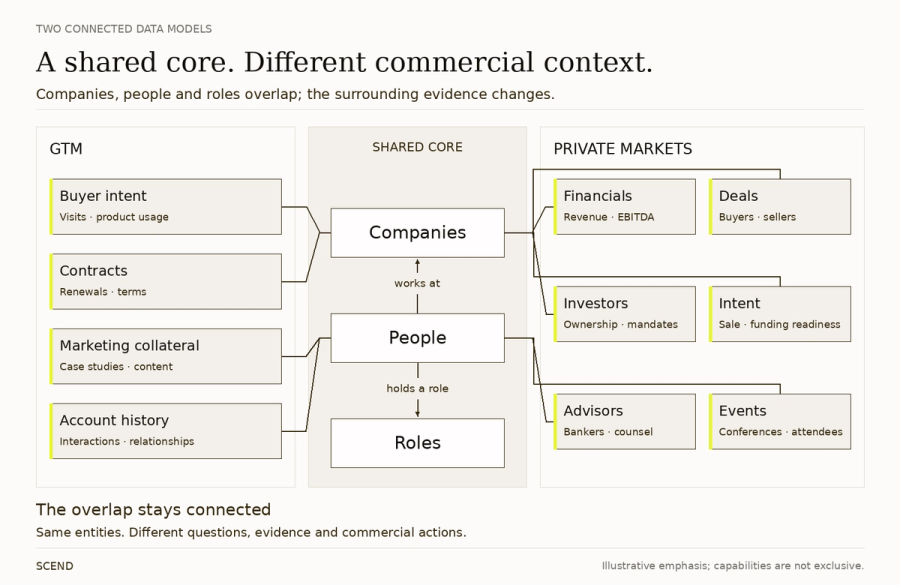
To build something minimally useful for sales, the core components are quite similar to LinkedIn's knowledge graph:
- People
- Companies
- Jobs / Roles (relationship between people and companies, and can also function as signals [job changes and new openings])
That's why the simplest GTM tools are just LinkedIn wrappers.
From there, hardcore GTM intelligence platforms layers in more context:
- Marketing collateral
- Contracts (i.e. renewal timing)
- Buying intent signals
- Account relationship history
Private-market origination requires a different set of hardcore context:
- People
- Companies
- Roles
- Financials
- Deals
- Investors
- Intent
- Advisors
- Events
Consider how much information is contained in a single acquisition.
The transaction connects a buyer, seller, management team, PE firm, investment bankers, lenders, attorneys, valuation, industry, and geography.
The relationships matter as much as the individual records.
Knowing a banker exists is useful. Knowing that banker advised three similar acquisitions in your target industry is much more useful.
Knowing a PE firm owns an HVAC company is useful. Knowing it completed five add-on acquisitions, which businesses it bought, and which advisors were involved begins to reveals intent (an acquisition strategy).
The same transaction could point an investment banker toward potential buyers, a PE firm toward new targets, a recruiter toward experienced executives, or a professional services firm toward customers needing integration support.
None of these data categories is new. Private markets leans a bit more on PitchBook's database model (rather than LinkedIn's), which has collected transaction intelligence for years. What's exciting is connecting that depth of information to research, decisions, and execution.
At Scend, we've spent an enormous amount of time understanding how many legitimate companies are missing from conventional databases. As we've expanded into market research, investor intelligence, and transaction data, it's become increasingly clear that finding the companies is only the beginning.
Outreach really matters but understanding how they're connected is what makes the information actionable and gives the green light.
The same company, different opportunities
An HVAC operator doesn't have one permanent role in the economy.
It might be an attractive acquisition target, a potential customer, a referral partner, or the former employer of an executive who has already executed the expansion strategy you're considering.
Which relationship matters depends on what you're trying to accomplish.
And identifying an opportunity doesn't necessarily mean you should act on it.
An attractive acquisition target may have no interest in selling. A relevant banker may have no reason to make an introduction. A conference full of industry participants may still be a poor use of time.
The next step is combining market intelligence with an objective, relationship history, and judgment to prioritize how to develop the opportunity.
What happens when origination becomes proactive?
Imagine telling a system you're looking to acquire founder-owned healthcare companies in the Northeast.
Rather than simply returning a target list, it could identify owners, research their businesses, and help initiate conversations.
But it might also suggest three bankers who have advised comparable transactions, an industry conference worth attending, or research that could help develop relationships with owners years before they're ready to sell.
An agent that blindly sends emails, LinkedIn messages, or meeting invitations can do more damage than good. The early complaints about AI SDRs are a reminder that automated activity isn't the same as valuable activity.
A system that understands which relationships are worth developing, prioritizes heavily, executes appropriate actions, and learns from the results could provide a very different kind of leverage.
For our HVAC platform, that might mean identifying a potential add-on, finding a lender capable of financing it, developing a relationship with the founder, and simultaneously identifying customers for the combined business.
The underlying intelligence is shared. The commercial objectives are different.
The next competitive advantage in origination may not be who sends the most founder emails, or even who finds the most acquisition targets.
It may be who best understands the relationships between companies, capital, people, and markets, and proves their right to win the deal. That's for another blog post.