
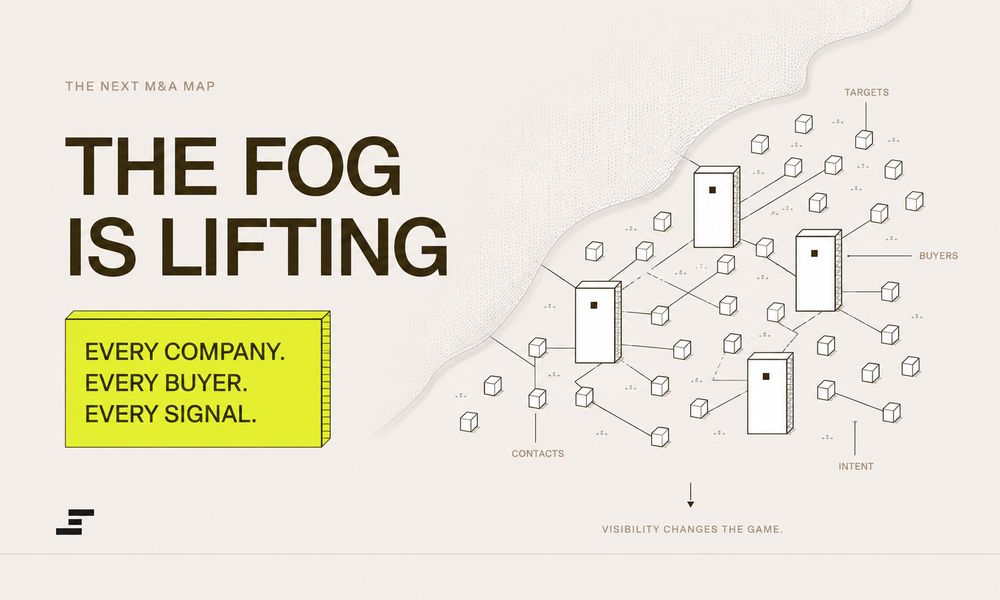
M&A has always operated through a fog of war.
Buyers don't know every company they could acquire. Owners don't know every buyer that might value their business. Neither side necessarily knows who is serious, who has capital, who might sell, or why a particular combination is the best fit.
Humans were wired 100-person villages, not millions of companies and decision makers.
An entire ecosystem emerged to reduce that uncertainty and connect a much larger set of dots.
The fog of war has already been shrinking
Here's a quick timeline:
- 1590: Berenberg Bank opened the oldest investment bank. Investment bankers connected owners and buyers because they had a personal rolodex of prior transaction participants. Relationships lived in their heads.
- 1946: J.H. Whitney created the first PE firm. The private equity asset class created a never-ending class of acquirers.
- 1996: BizBuySell was founded as an M&A marketplace. Online marketplaces made some selling businesses visible just like home listings.
- 1998: CapIQ created the public markets databases so you could start to find public businesses who may or may not be available for take privates.
- 2007: PitchBook started organizing the transacted private markets curated by a human data analyst team, now with 13mm companies indexed.
- 2014: SourceScrub had humans go less deep into company financials but but a bit broader into the middle market and now has 17mm companies.
- 2016: Grata expanded coverage again mainly with NLP (pre-LLMs) and sits at 22mm companies in its database
- 2024 (Post-LLMs): Scend is pushing toward a world where M&A can potentially identify nearly every relevant company by indexing the unstructured web and waterfalling multiple databases instead of just one. For example, there's 69 million companies on LinkedIn and 250 million businesses and place on Google Maps.
The next layer is filtering, which is figuring out from the full universe which ones are relevant (size, ownership, growth, margins, domain-specific stuff, etc.).
After that, you need contact details of the decision maker (name, title, email, phone number, address).
Then comes understanding signals like intent, not just which relevant targets exists. Timing is crucial.
Is the owner approaching retirement? Are there family members running the business to succeed the owner? Is the PortCo nearing the end of it's hold cycle? Which investors actually have capital to deploy? What's their buy box? Who's the right investor at the fund that specializes in that sector? Which strategic buyers have a reason to act? Which combinations make enough sense that someone could create a transaction that didn't previously exist?
Now imagine all parties have access to all of this on either side of a transaction, whether they use Scend or build their own in-house tooling or other providers independently reverse engineer feature parity.
If assets, buyers, contacts, and intent all become increasingly visible, what happens to M&A when it feels like everyone is on the same playing field?
However, let me take a step back and give some context.
Investors have always sought alpha
To be clear, it was never an even playing field.
Some PE firms had bigger brands and bankers just sent them more dealflow. The earliest opportunity was often simply buying a company at an attractive price.
As the market matured, leverage became more widely available. Investors could win more deals by paying more but still amplify equity returns by financing more of the purchase price with debt.
As capital and leverage became more widely accessible, investors increasingly emphasized proprietary sourcing.
If you could find an attractive company before it hired a banker, you might avoid a competitive process and buy it at a better price.
This is an oversimplification, but the progression was directionally:
Buy an affordable company.
Finance it more efficiently.
Find it before everyone else.
Each source of alpha attracted more competition.
More PE firms started covering the same sectors until they were all mapped. More lenders could finance transactions. More funds hired business development teams. Search funds, independent sponsors, family offices and strategic acquirers joined the hunt.
The phrase proprietary deal flow became nearly universal.
Now, better technology is beginning to commoditize company discovery too.
What happens next?
We think 4 things are most likely:
- A proper private market marketplace could emerge
- Persuasion becomes the new frontier in alpha
- Bankers become more valuable as advisors
- Value creation becomes the final frontier in alpha
A real marketplace may not look like listings
A true private-market marketplace probably won't look like BizBuySell.
Owners want discretion. Many want to speak with an adviser before a buyer, and they don't want employees, customers, or competitors to know that a sale is being considered.
The likely model is opt-in, private, and multi-stage. An owner could signal openness without broadly listing the company. First qualified bankers connect. Then lawyers. Then qualified buyers could be revealed gradually, with sensitive information shared only as mutual interest develops.
Technology may identify the match before either party formally enters a process.
Winning moves from identification to persuasion
When every investor can find the same company, owner, email, and phone number, sending three emails with basic follow-ups isn't much of an advantage.
Origination will need to look more like lifecycle marketing.
An owner might discover an investor through a market map, read several thoughtful articles, receive a useful benchmark, see the firm at a conference, attend its executive dinner, and speak with a portfolio CEO before ever discussing a transaction.
Email will remain one channel, but firms may add newsletters, events, gifting, direct mail, paid advertising, video, and community building. I think M&A marketing should start looking more like sophisticated consumer or enterprise marketing than a basic SDR cadence.
This is how investors demonstrate domain expertise, culture, and buyer intent over time.
The highest-order sourcing may go further. Finding an owner who already exhibits retirement or succession signals is valuable. Convincing an owner with no existing intent that you are the right partner for the company's next chapter is much harder.
A good investor will stay around the hoop when the seller is ready.
A great investor can create a compelling reason to partner.
Bankers become advisers instead of rolodexes
This makes trusted bankers more valuable, not less.
If technology can identify possible buyers, owners will need more help deciding whether to sell, whom to trust, how to preserve confidentiality, and which partner offers the best cultural and strategic fit.
The banker becomes less valuable as a human rolodex and more valuable as an advisor, therapist, and negotiator.
Value creation becomes the strongest source of alpha
More visibility should create more competition for attractive companies.
Investors can move faster, build stronger relationships, or pay more. But the most sustainable way to pay more is to create more value after closing.
Domain expertise, GTM, technology, talent, M&A integration, and a credible operating plan become part of how the deal is sourced and won.
The progression becomes:
- Buy an affordable company.
- Finance it more efficiently.
- Find it before everyone else.
- Earn the right to buy it
- Improve it better than everyone else.
Everyone may eventually see all the names the map.
Very few will know how to win the territory.