
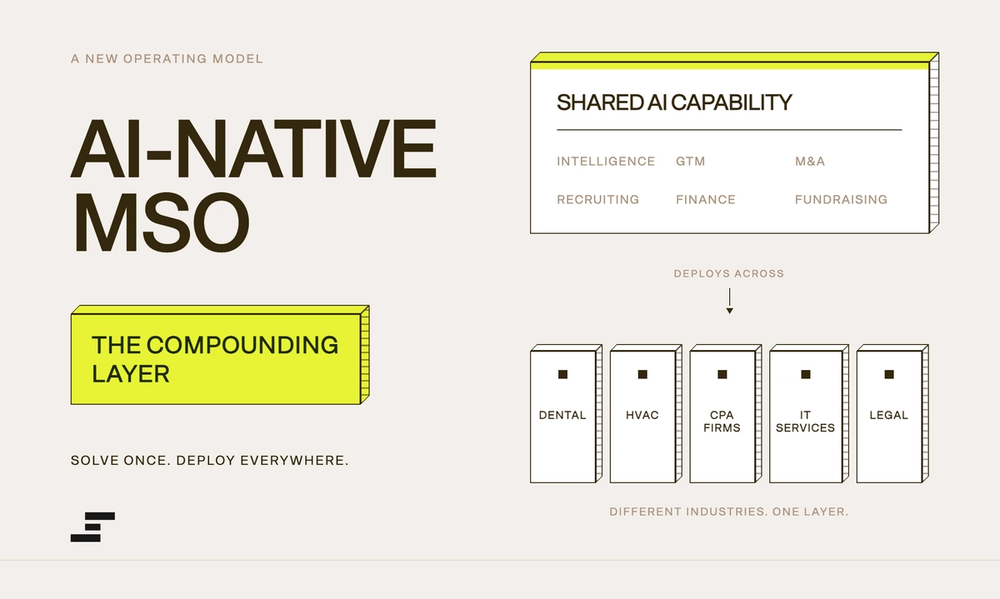
PE has spent decades trying to answer one question after an acquisition:
What can be centralized?
An SMB shouldn't need to independently build every capability required to compete:
- Intelligence/Data
- GTM
- M&A
- Recruiting
- Fundraising
- Finance
- Rest of Ops (Procurement, AR/AP, etc.)
The traditional answer was the Management Services Organization (MSO).
The SMBs kept doing what made them valuable. The MSO built a common layer around them.
In my opinion, what started as a simple business and regulatory solution (it also created a legal structure for VC and PE to invest into professionally licensed markets) has now become a massive new opportunity. AI could make the MSO model dramatically more powerful.
The next iteration of MSOs may support multiple industries, have far fewer employees, and increasingly perform even more work.
I'd like to think of it as a compounding layer.
However, let me take a step back and give some context.
MSOs aren't new
Healthcare provides the clearest precedent, and dental took this particularly far.
The MSO model separates the underlying professional service business from centralized non-clinical services.
Heartland Dental was founded in 1997 around the idea that dentists could lead their practices while a larger organization provided back-office support. Today, Heartland supports more than 1,900 practices.
Aspen Dental followed a similar model. What became The Aspen Group eventually expanded beyond dentistry into urgent care, medical aesthetics and veterinary care.
Heartland, Aspen, PDS Health, MB2 Dental and other large support organizations now touch thousands of practices. This is also happening across every sub-sector in healthcare services.
The logic is pretty straightforward: a clinician should spend more time practicing clinical work and as little time as possible running payroll, negotiating insurance contracts, fighting denials, recruiting staff, or figuring out ROAS.
Those functions can be centralized and run by non-clinical talent. And once centralized, the organization can build capabilities no individual practice could economically justify on its own.
However, there was a constraint: most shared capabilities required people.
Supporting 10x as many businesses generally required more centralized labor.
AI obviously changes that equation.
From shared services to a common layer
Some of the most interesting companies today don't call themselves MSOs at all.
Beacon Software calls itself a permanent holding company.
It buys niche software businesses and leaves their brands and teams intact. Above them, Beacon has built what it explicitly calls “A Common Layer.”
This is the literal hero text on its website:
“A common layer for the Everyday Economy.”
That includes engineering and product, applied AI, GTM, finance, operating talent and M&A.
Thrive is rebuilding the work itself
Thrive Holdings takes the idea another step.
Thrive owns and operates businesses starting in accounting and IT services, but its thesis isn't simply to buy fragmented firms and consolidate the back office.
OpenAI became an investor in Thrive Holdings in 2025, with the two companies working together to deploy frontier AI directly into Thrive's operating businesses.
Thrive describes the model particularly well:
The problem is found locally. The answer is solved once. Then it is shared across the network.
A tax workflow improved inside one accounting firm doesn't need to remain a bespoke solution. The agents, data, evaluations, integrations and operating knowledge can become shared infrastructure.
That creates a very different flywheel.
More firms create more workflows. More workflows create more feedback. More intelligence moat.
Now keep going. More acquisitions. More GTM. More fundraising.
The common layer becomes more valuable as the network grows. All synergistic and all compounding.
Long Lake shows why this may not need to stay vertical
The obvious objection is that MSOs have been vertical for a reason.
Dental is just so different from legal. The customers, regulations, tech stack, and workflows differ.
So how could the same operating layer span multiple industries?
Long Lake is an interesting answer.
Founded in 2023, Long Lake applies technology across the broader services economy rather than concentrating in one narrow vertical. Its Nexus AI platform is designed as a horizontal layer between frontier models and the data and workflows inside each business.
The architecture is increasingly: horizontal infrastructure with vertical context.
The system doesn't need dentistry and HVAC to operate identically.
It needs reusable infrastructure for understanding data, workflows, decisions, actions and feedback, then enough domain context to adapt to the underlying business.
An AI-native MSO prioritizes workflows that easily transfer across industries
The AI-native MSO shouldn't initially try to operate everything.
Some workflows, like healthcare denial management, are deeply vertical-specific. On day one, leave the EMR alone.
Others are surprisingly horizontal, particularly those built around finding and building relationships:
- M&A
- GTM
- Partnerships
- Fundraising
- Recruiting
The context changes, but the steps are very similar:
Define the target → map the universe → identify the right people → research and prioritize → initiate outreach → manage the relationship.
An AI-native MSO could increasingly perform that common work for different industries while humans retain the relationships and important decisions.
Organic and inorganic growth can become the first compounding loop
Imagine an HVAC platform.
The common layer improves GTM and the number of customers in that firm's region. Then the platform acquires another operator in another region.
That acquisition brings new customers, branches, data and relationships, and immediately inherits the same growth infrastructure.
Better operations make acquisitions more valuable, increase the deal multiple you can pay, and improve win rates. Acquisitions create more surface area for better operations.
Across an entire PE portfolio, the effect compounds again: workflows developed for one PortCo make the next deployment cheaper and faster.
An AI-native MSO doesn't necessarily need to own the businesses
This is where an AI-native MSO could differ from Beacon, Thrive and Long Lake.
Those AI rollups buy businesses and deploy common capabilities across what they own.
I always thought all MSOs were practically owning professional practices by paying out the SMBs while the legal docs had “arms-length, fair market agreements” but essentially swept back the profits.
What if it was really arms-length, though, and not just legal smoke and mirrors?
An AI-native MSO could let private equity supply the ownership layer while it supplies the operating layer.
That makes the MSO model dramatically less capital intensive.
The first deployment might look like AI transformation work. But each engagement creates reusable agents, integrations, data models and workflows.
Over time, implementation becomes more like assembling Lego blocks than bespoke consulting.
I looked it up and there are at least two meaningful precedents for this structure:
- Franchises provide independently owned businesses with common brands, suppliers, systems, playbooks and shared infrastructure.
- Hotel management companies like Aimbridge Hospitality and Marriott Hotels can operate hotels they don't own, handling major operating functions in exchange for recurring management fees and often incentive fees tied to performance.
The AI-native MSO could sit somewhere between the two:
Franchise-like reusable infrastructure + management-company responsibility for execution.
The economics can compound too
That creates a model somewhere between SaaS, consulting and traditional management.
There may be:
- Implementation fees
- Recurring software
- Management fees
- Performance participation
- Equity, options or warrants
If the provider only supplies software, it should charge like software.
But if it increasingly operates a company's GTM or M&A capability, MSO-like economics become much more defensible.
Unlike an AI roll-up, it doesn't necessarily need hundreds of millions of dollars to buy the businesses underneath it.
The first deployment may be expensive.
The tenth should be easier.
The hundredth should be dramatically easier.
The AI-native MSO gets thinner as it gets bigger.