
I’ve been thinking about what an actually AI-native private equity firm would look like.
What it doesn’t look like:
- 50 investment professionals with Claude licenses
- Associates shoving CIMs and data rooms into LLM wrappers
- AI-generated IC memos and financial models layered onto the exact same organization
That’s just traditional private equity using LLMs with context.
If you started a PE firm from scratch today, the ambition should probably be much bigger.
Private equity’s current economics were built around expensive human intelligence.
MDs source. VPs run diligence. Associates model. IR teams fundraise. Finance teams report to LPs. Operating teams work with portfolio companies.
That human intensity affects everything:
- Why funds charge 2% management fees
- Why minimum check sizes exist
- Why sourcing is episodic
- Why portfolios are relatively concentrated
- Why firms need large pyramids of junior talent
- Why managers depend so heavily on outside capital
If AI makes a meaningful portion of that intelligence dramatically cheaper, the interesting question isn’t just:
How much more productive can a PE employee become?
This is the paradigm/step-function shift:
Which parts of the private equity business model stop making sense?
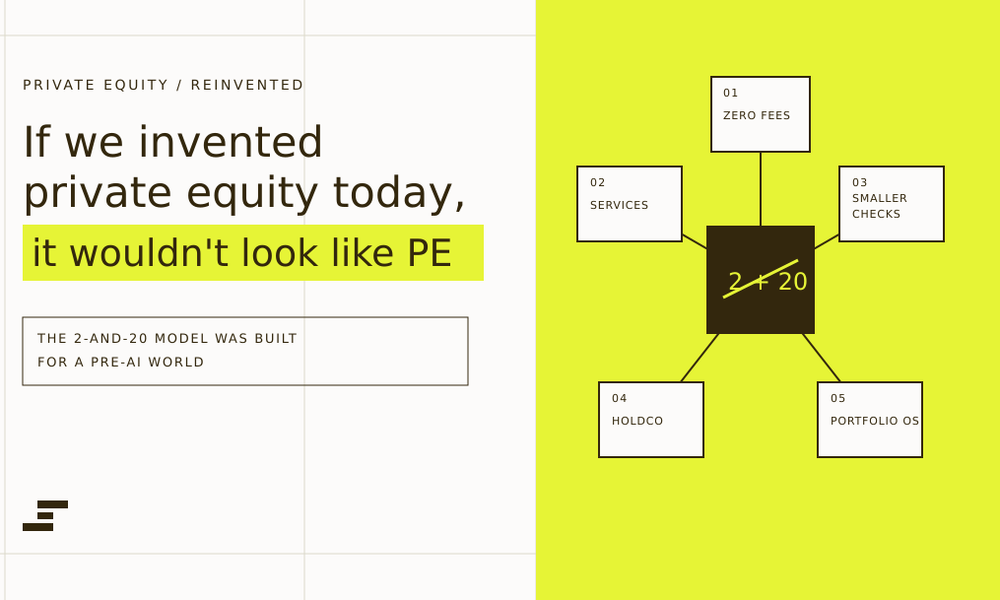
I'm hovering in on these five possibilities.
1. The management fee could go to zero
Private equity is expensive to operate because so much of the work has historically been human-intensive and those particular humans are expensive.
MDs source. VPs run diligence. Associates model. IR teams fundraise. Finance report to LPs. Secretaries schedule.
That’s a big reason the 2% management fee exists. A $1 billion fund needs to cover overhead until carry comes in.
But what if a $1 billion fund could be run by 10 exceptional people instead of 50 people?
AI could continuously:
- Source proprietary deals
- Flush out more investment banker relationships
- Negotiate all NDAs
- Contact and line up all vendors in a live deal (lawyers, consultants, etc.)
- Draft IC materials and models
- Monitor portfolios
- Identify all exits/buyers
You’d still 100% need humans for judgment, relationships, negotiation, and capital allocation.
But the cost base could look very different with 10 people versus 50, which creates a very compelling fundraising pitch:
0% management fee. We primarily make money when you make money.
Maybe it’s 1-and-25 for Fund I and 0-and-30 for Fund II onwards instead of 2-and-20.
The obvious problem is that carry might not show up for five years.
Those 10 people still need salaries.
Which leads to the second idea.
2. The moat might be worth selling
If your competitive advantage is proprietary AI that can map industries, find companies, identify buyers, and research markets better than traditional workflows, why keep it entirely internal?
Other people will pay for that.
An AI-native PE firm could also sell:
- Excess deal flow (M&A sourcing)
- Market intelligence
- Strategic research
- Corp dev support
- Capital raising
- Advisory
Now the same infrastructure that helps you invest also generates current revenue.
That starts looking less like a PE firm and more like an AI-native merchant bank.
And there’s a second benefit.
The advisory business could become the sourcing engine.
If you’re helping hundreds of companies think through acquisitions, capital raises, and strategic alternatives, you’re constantly seeing who wants to buy, who wants to sell, and which industries are moving.
Traditional PE firms spend a lot of money manufacturing proprietary deal flow.
An AI-native merchant bank could potentially get paid to create it.
3. Minimum check sizes could collapse
This might be one of the biggest implications.
PE firms don’t only move upmarket because they have more capital.
They move upmarket because human attention/focus is expensive.
A $10 million equity check requires practically as much sourcing, diligence, legal work, and portfolio oversight as a $100 million check.
That makes smaller deals sub-scale for large firms.
AI changes the fixed-cost equation.
If research, sourcing, initial underwriting, and monitoring become dramatically cheaper, an institutional-quality investor may be able to make $2 million, $5 million, or $10 million checks economically.
That opens a huge universe of companies that institutional PE mostly ignores today. It could be expanding what is investable at all.
4. Successful exits could eventually turn the firm into a holdco
At the beginning, the firm would probably still depend heavily on LP capital.
Investors fund the acquisitions.
The manager contributes a small amount, earns carry, and maybe co-invests.
But over time, the economics could compound differently.
Fund I exits.
The parent company retains some carry and service profits.
Now it can put more money into Fund II deals.
Fund II exits.
The parent’s balance sheet gets bigger again.
Eventually, you could move from:
- Asset manager
- Merchant bank
- Hybrid investor
- Permanent-capital holdco
Outside LP capital becomes the bootstrap mechanism.
The better the firm performs, the less dependent it becomes on constantly raising outside capital.
And eventually, it may not need to sell a great company just because a 10-year fund life is ending.
AI-native PE starts looking more like Berkshire or Constellation Software than a traditional PE firm.
5. Value creation could become the actual moat
This is the part I find most interesting, but also the easiest one to get wrong.
If AI makes sourcing cheaper for everyone, simply finding a company may become less differentiated. Even PE firms not building internally may use Scend to remove the 'fog of war' in sourcing.
The harder question becomes:
What can you do to the business after you buy it that another owner can’t?
An AI-native PE firm could build a shared operating layer across the portfolio:
- Turn-key GTM
- Customer support
- Talent/Recruiting engines
- Finance
- Add-on sourcing
But I don’t think the answer is replacing 30 investment professionals with 30 operating partners.
That recreates the same cost problem.
The goal could be a thin, reusable operating system.
Every portfolio company plugs into the same technology, playbooks, data, and automation layer. Large VCs have vendor partnerships but can't be as heavy-handed because they don't own majority control. A PE firms can make this implementation compulsory.
Instead of building bespoke solutions for each company, the platform improves every acquired company at once.
Some of that could even become another revenue source.
If the operating system saves a portfolio company $1 million a year or materially improves revenue, there’s no reason the parent company couldn’t charge for parts of that infrastructure. An AI-native PE firm could essentially operate as a management services organization (MSO).
So what is the company?
Honestly, I’m still thinking this part through because there's so many ideas.
It might start as a PE firm.
Then it monetizes some of its internal technology and starts looking like a merchant bank.
Successful investments build the parent balance sheet.
Eventually, the parent owns more assets directly and starts looking like a holdco.
Meanwhile, the operating infrastructure becomes increasingly important to why the firm wins deals in the first place.
The end state could be some combination of:
- Merchant bank
- PE firm
- Software company
- Management services organization
- Permanent-capital holdco
It's quite messy but successful companies often do and they're applauded for it.
The most interesting AI-native businesses probably won’t fit neatly into categories created before AI existed.
The best question I can leave you with:
If intelligence becomes dramatically cheaper, what parts of the private equity business model no longer make sense?